








About Malta About Us Hotels Excursions in Malta English Courses
Bg
 
Exotic Sardinia Charming Sicily Fascinating Bulgaria


A B O U T    M A L T A

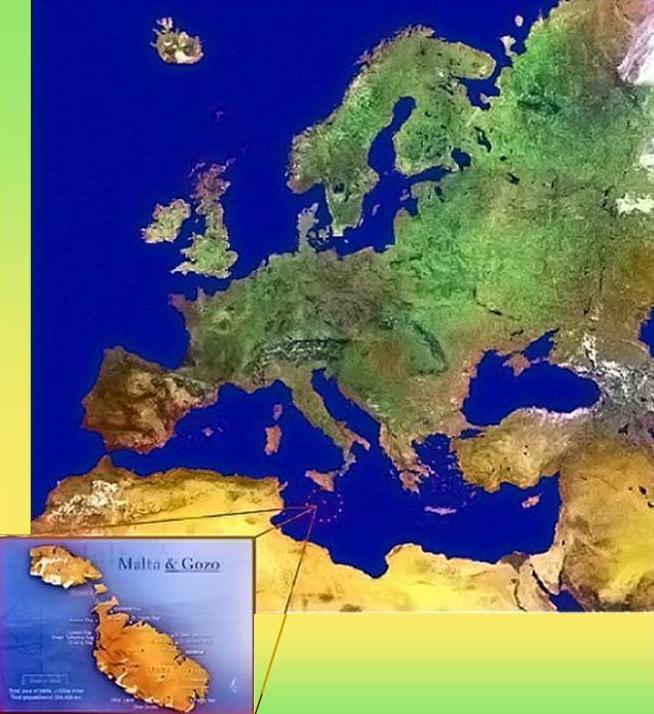
Located in the Mediterranean Sea, just south of Sicily, the Maltese archipelago basically consists of three islands, Malta, Gozo and Comino with an area of about 316 sq.km. Their total population is about 400 000.


The largest island of the group is Malta with 237 sq.km in area, from which the archipelago takes its name. It has a population of just over 370000. Valletta, the capital, is the cultural, administrative, and commercial centre of the archipelago. Malta is well served with harbours, chief of which is the Valletta Grand Harbour. Its international airport is at Luqa, five kilometres from the capital.
The second largest island is Gozo. It is topographically quite different from Malta, and is quaintly attractive for its less industrialised way of life. Gozo can be reached from Malta by ferry-boat.
Comino, Cominotto, Filfla and St Pauls Islet are the other major features of the archipelago. Of these, only Comino, straddled between Malta and Gozo, sustains a tiny population of 4 persons. Turned into a popular resort because of a couple of very fine beaches, Comino can be reached either by boat or by excursion ferries during the summer months.

The distance between Malta and the nearest point in Sicily is 93 km. The distance from the nearest point on the North African mainland (Tunisia) is 288 km. Gibraltar is 1,826 km to the west and Alexandria is 1,510 km to the east.
This strategic position has allowed Malta to develop as an important trading post. The Malta Freeport is one of the leading ports in the Mediterranean for container transshipment.

Climate
The climate in Malta is warm and healthy. There are no biting winds, fog, snow, or frost. Rain falls for only short periods and averages about 578 mm in a whole year. The temperature averages 14.1° C in winter (Nov-April) and 32° C in summer (May-Oct).

Pre-history
About seven thousand years ago, men came to the Island of Malta, using rafts and bringing with them livestock, utensils and seed. They occupied the archipelago and developed a community, which was well established during the Neolithic Age.
The Maltese Neolithic communities developed their crafts and particularly their ability to produce and decorate pottery and to carve stone and build magnificent megalithic temples. They also dug burial grounds and an underground temple, known as the Hypogeum, implying a cult of Dead.

The temples of Mgarr, Tarxien, Hagar Qim, Mnajdra and Ggantija are megalithic remains

which stand out as evidence of the fact that life centred round the religious cult of the Mother Goddess represented by massive statues commonly referred to as "The Fat Lady".

The pre-historic settlers of Malta remained shrouded in mystery until some time in the Ninth century B.C. Phoenician seafarers came to the Island and colonized it.

Punic and Roman Times
The Phoenicians appreciated the strategic value of the Maltese Islands and started to make use of them. Presumably they founded the cities of Malta and Gaulos in the Centre of the islands while rock-cut tombs indicate their presence inland. When the Phoenician homeland was overrun by the Assyrians and Babylonians, the Carthaginians took over the Islands and started using them as a trading post. While a Maltese government system similar to that of the Carthaginians seems to have evolved, Maltese trade gained in reputation particularly in the production of textiles.
The Romans took Malta during the Second Punic War in 218 B.C. Under Roman rule, the Maltese were considered as confederates, allies, and they had their own government. The inhabitants prospered and they became wealthy and increased in population. They built country houses embellished with mosaic floors, thermae and marble statues while the cities of Melita and Gaulos gained in importance. The Romans governed these islands until the division of the Roman Empire in 4th century AD.
The A.D. 60, St. Paul was shipwrecked in Malta. Christianity started to spread. Christian communities started organising their own holy places and dug catacombs, which are exceptionally well laid and excavated.

Then followed an obscure period during which the Byzantines occupied the Islands.


Mediaeval Malta
For more than two centuries, the Maltese Islands were under Arab rule (870-1090) and when the Arab rulers were driven out, they left behind them notable imprints of their culture on the language of the Maltese people. In 1090, Count Roger the Norman with a small force, landed in Malta. The Arabs did not offer any resistance and after negotiations with Count Roger it was agreed that they were to continue to govern the islands, but they had to pay an annual tribute to Roger the Norman. The Maltese Islands were formally incorporated with the Sicilian Crown about the year 1123 when Sicily was governed by Roger II (1105-1154), the Son of Roger the Norman. In April 1283, at the request of the Maltese, the new sovereign of Sicily incorporated Malta with the Sicilian crown. During the fourteenth century, the Maltese Islands were given to a series of Feudal lords.
In the following century there were no feudal lords in the Maltese Islands and there was very little interference from Sicily. The Maltese Islands had a local government, the Universita made up of the government officials who carried on the day to day administration, and the Consiglio Popolare, or local Council, which although it could deliberate local affairs had no legislative power.

Malta under the Knights: 1566 – 1798

By a decree dated the 23rd March 1530 the Emperor Charles V ceded the Islands of Malta and Gozo and the fortress of Tripoli, in North Africa, to the Sovereign Military Order of St John which was in search of a new home after the loss of Rhodes in December 1522. The islands were donated to the Order for an annual token rent of one falcon.
The Knights were less than enthusiastic about the prospect of Malta. A reconnaissance party reported back to Grand Master L Isle Adam that Malta was a barren rock, but without much choice they decided to move to Malta.
Grand Master Phillipe Villiers and a great part of the Convent arrived in Malta on the 26th October 1530 and took up residence at Birgu, which now became the headquarters of a Sovereign Military Order.

Malta entered a new era that would change its fortunes for ever.
The Order took steps to straighten the island's defenses, by erecting two forts. In May 1565 a Turkish armada appeared over the horizon, consisting of about 200 vessels with about 40,000 men on board. The knights and Maltese retreated within the fortification. The Turks attacked several times but the towns offered a valiant resistance to the attacks. On the 7th September 1565 the long expected relief force arrived from Sicily and the Turks immediately raised the siege and departed.
For the next two and half centuries, Malta played a leading role in the region, starting with this famous Grand Siege of 1565. It put a halt to the Turkish menace to Christian Europe and heralded Maltas “Golden Age”.
The Knights founded their new city, Valletta, and within a few years Mdina became Citta Vecchia - the old city, with only a handful of inhabitants.

Resentment and Changes: 1798 - 1815
In June 1798, a French armada under the command of General Bonaparte appeared on the horizon. Following a feeble resistance, the Knights capitulated and the Maltese Islands fell under French rule. The French carried out a number of reforms. However a number of their measures caused resentment among the Maltese and on the 2nd September 1798 the Maltese rose against the French. Within the space of a few hours Mdina and the whole of the countryside fell into the hands of the Maltese.
The Maltese insurgents set up Provisional Government and set up batteries at strategic points. Help was obtained from Naples and in 1799 following a request from the Maltese the Maltese Islands were placed under the special protection of His Britannic Majesty.

During the Napoleonic Wars, Malta experienced an economic boom due to the Continental System. The war between England and France came to an end in 1814 and according to the Treaty of Paris (1814) the Maltese Islands formally became part of the British Empire. From then on, Malta became an important component of the British Empire, a strategic stronghold in the region and a stepping stone for British expansion to the East. Through cycles of war and peace, Malta’s fortunes were inextricably linked to those of Britain.

Colonialism vs Maltese Rights: 1815 - 1886
Although the Maltese had willingly placed themselves under British rule a section of the Maltese resented the fact that the Maltese had absolutely no say in the administration of their island home. However, in 1835, Council of Government consisting of only nominated members was granted and in 1849 a new Constitution was granted to the Maltese .
After the Royal Commission of 1836 primary schools were opened in various towns and villages and by 1880 there was a primary school in every town and village, although attendance was not compulsory.
The transport system also improved. The omnibus was introduced in 1856 and was followed by the railway in 1883. In 1882 the steam ferry service was introduced between Sliema and Valletta and three years later, in 1885, a regular form of transport was introduced between Malta and Gozo.
The British Government continued to strengthen the islands defences, and a number of forts and the "Victoria Lines" were erected. The importance of British Naval Power also led to the considerable development of the Naval dockyard with the construction of new docks .A number of important public works were also carried out such as the new commercial harbour at Marsa, a new Mental Hospital in Attard and the Royal Opera House in Valletta.

Self-Government and Courage: 1921 - 1945
In 1921 Malta was granted the Amery-Milner Constitution, which ensured autonomy in internal affairs. Control was divided between a Maltese government and an Imperial government, which had control over many "reserved matters".
The dark clouds of the World War II that were gathering made the Maltese unite in defence of democracy and civilisation. Following Italy's entry into the War, Malta started to suffer air-raid bombing. While Italian and German bombers brought havoc to the Maltese islands, which were at first defended notably by three Gladiators named Hope, Faith and Charity, the problem of supplies was soon felt. But the people's heroism withstood every attack. On the 15th April 1942 King George VI awarded the George Cross to the people of Malta in appreciation of their heroism.

Malta gains Independence, 21st September 1964
After the war, the movement for self-determination grew increasingly stronger. And finally Malta was granted its independence on September 21st, 1964. Malta became a democratic constitutional monarchy with Elizabeth II declared as Queen of Malta. The British forces retained a presence in Malta, until March 31st, 1979, when all foreign military bases on the island were closed down.

A Nation amongst Nations: 1964 - 1989
Once Independence was achieved, Malta started to play her part in international relations. Her independence was immediately recognised by China, USA and USSR and she soon started to join international organisations.
On the 20th August 1964 parliament had approved without opposition her membership in the Commonwealth. Soon after Independence, she joined the United Nations Organisation.

In 1974 Malta was declared a Republic within the Commonwealth.

In January 1987 Malta was declared a neutral state and non-aligned, without a military base or foreign interference.

U s e f u l  I n f o r m a t i o n

Currency
The Lira ( LM) is the unity of currency and is divided into 100 cents.
Current rate of exchange against USD - 1 LM approx 3.00 $
Current rate of exchange against Euro - 1 LM approx. 2.45 Euro


Banks
Usually open 8.30 a.m. till 12.30 p.m. Mondays to Fridays and up to 11.30 a.m. on Saturdays. Foreign exchange facilities are available at Luqa Airport 24 hours all the year round and up to 4 pm at most banks. Automated machines are situated in the major commercial and tourist areas.

Shopping
Shops are usually open between 9 am and 7 pm with three or four hours lunch break .In commercial areas most shops remain open till 8 pm. There are open area markets in most towns and villages. The largest is the one in Valletta on Sunday mornings.
Major Credit Cards, Travelers’’ cheques and Eurocheques are accepted at most leading shops and restaurants.

Time
Malta is one hour ahead of GTM.

Car Hire
Malta has the cheapest car hire rates in Europe. Prices start from Lm 5.50 per day incl. insurance. Driving is on the left!

Bars, restaurants and cafes
They are normally open after 11 a.m. till early morning (for bars)

Discos
There is a number of lively discos, particularly in Paceville, the most poplar entertainments’ place in Malta with more than 50 discos, bars, cafes, restaurants. Several open-air discos operate only during summer.

Casino
There three casinos in Malta: in St. Julian’s, Bugibba towns and Cospicua towns.


Sporting Facilities
Golf, tennis, squash, badminton, scuba diving, windsurfing, sailing and yachting, paragliding. Football, bowling, horse riding, horse racing, clay pigeon shooting, archery, basketball, table tennis, swimming, etc.

P l a c e s  o f  I n t e r e s t

Valletta is named after its founder, the respected Grand Master of the Order of St John, Jean Parisot de la Vallette.
The city had been planned before the Great Siege. But the plans could only be executed once a grateful Christendom had lavished riches on the Knights for their defeat of Suleiman. Following the raising of the Great Siege Grand Master Jean Parisot de La Valette decided to erect a new city. The first stone of the new city, which was named Valletta, in honour of the Grand Master, was laid on 28th March 1566. However, La Valette died in 1568, before the city was completed.

The magnificent fortress city grew on the arid rock of Mount Sceberras peninsula, which rises steeply from two deep harbours, Marsamxett and Grand Harbour. Started in 1566, Valletta was completed, with its impressive bastions, forts and cathedral, in the astonishingly short time of 15 years. By the turn of the 16th century, Valletta was a sizeable city. People from across the Islands came to live within the safety of its bastions. During the Order's rule, the population of the Maltese Islands increased considerably from approximately 25,000 in 1530 to 91,273.


The new city of Valletta was provided with the necessary amenities such as an adequate water supply, a hospital, law courts, theatre, bibliotheca and a customs house.In 1592 the Jesuit opened a Collage in Valletta and in 1769 Grand Master Emmanuel Pinto established a University.

The city catered well for all strata of society, from the Knights to their servants and trades people. The grid of streets allowed for fresh air from the two harbours to circulate easily in the narrow streets – a kind of city-scale air-conditioning.
Valletta is a fine example of a planned, 16th century city: unusual for the times, since urban centres mostly evolved from earlier settlements. Valletta was soon pre-eminent in the life of the Order and the Islands. However, the Three Cities, across the harbour,

the first home to the Knights, retained economic importance because of their docks. Mdina, the old medieval capital, all but lost its role and became a backwater. It remained home to the Maltese nobility, descendents of the Sicilian and Spanish overlords.

World War II brought havoc to Malta. Valletta was badly destroyed by bombardment, but the city managed to withstand the war with many of its treasures, such as the Knights' masterpiece, St John's Cathedral, intact.

Today Valletta has a smaller population than before the war, but it is a bustling place as the Islands' main business centre and the seat of government


St Johns Cathedral is the highlight of the Maltese Islands.

However short your stay on the Islands, this cathedral of the Knights of St John is a must to visit.


Described as the first complete example of the high baroque anywhere, it epitomises the role – spiritual and military - of its patrons.


The austere facade is reminiscent of the fortifications of Valletta, the fortress city in which it stands; while the exuberant and lavish baroque interior shows the Knights’ deep appreciation and patronage of culture and the arts.

The Cathedral is testimony to the talent of Maltese military architect, Gerolamo Cassar, and to Mattia Preti, the Calabrian artist and Knight. Preti designed the intricate carved stone walls and painted the vaulted ceiling and side altars with scenes from the life of St John. The Cathedral houses also one of Europe’s most impressive and famous art works, Caravaggio’s Beheading of St John the Baptist.

The Cathedral is a shrine to the Knights in another sense. Many sons of Europe’s noble families from the 16th to 18th centuries lie buried here. Their intricate, marble-inlaid tombstones form a magnificently crafted pavimento.
The inscriptions relate the story of the lives and valiant deeds of the Order.

Sir Walter Scott, in Malta in 1831, called the Cathedral the most magnificent place he had ever seen. It is certainly a spectacular building and a fitting resting place for the founder of Valletta, Grand Master Jean Parisot de la Vallette.

Palace of the Grand Masters,

completed in 1574. It contains portraits of the Grand Masters of the Order and European monarchs, interesting furniture, and other works of art. A unique collection of Gobelin Tapestries hangs in the Tapestry Chamber and the main hall is decorated with frescoes by Perez d'Aleccio, depicting episodes from the Great Siege. The decoration on the ceiling of the corridors is by Nicolo Nasoni. Many of the State apartments are decorated with friezes depicting episodes from the history of the Order. On view are works by Ribera, Van Loo and Batoni.

Converted from a smaller house, the Palace was designed by Gerolimo Cassar in 1571. From the time of its completion until the end of the Order of St.Johns reign in Malta (1798) the palace was used by all the Grand Masters. In 1800 it became the official residence of British Governors. The Palace contains some fine examples of medieval Armour and weapons used by the Knights of St. John and their adversaries.

The Palace is now the Presidential Office. Within the Palace, whose grand rooms are used for state occasions, is a wealth of splendour

The history of Mdina and its suburb Rabat is as old and as chequered as the history of Malta itself.

Mdina, Malta’s medieval capital,


can trace its origins back more than 4000 years. Rabat can claim the origins of Maltese Christianity. It was here in A.D. 60 that the Apostle St Paul is said to have lived after being shipwrecked on the Islands. Both Mdina and Rabat are fascinating to tour for their timeless atmosphere and their cultural and religious treasures.

Mdina has had different names and titles depending on its rulers and its role. It was Melita to the Romans; Medina to the Arabs; and Citta’ Vecchia, the old city, when Valletta became the lifeblood of the Islands. None describe it better than its medieval name, Citta’ Notabile, the noble city.


It was home then, as now, to Malta’s noble families; some are descendants of the Norman, Sicilian and Spanish overlords who made Mdina their home from the 12th century onwards. Their Impressive palaces line its narrow, shady streets. Mdina is one of Europe’s finest examples of an ancient walled city, and unusual in its mix of medieval and baroque architecture.

This ancient city stands like a sentinel on the high ground; its high position dominates the countryside. The site had been an ideal natural stronghold for the Island’s inhabitants since Neolithic times.

In 1693 Mdina was struck by an earthquake, when its medieval Cathedral and several old houses were damaged. St. Paul’s Cathedral was rebuilt in baroque style and consecrated in 1702.

Today Mdina has a quiet, restrained atmosphere in keeping with its noble past. Lamplit by night, Mdina transforms itself into the ‘Silent City’. For a relaxed evening, seek out the restaurants tucked away in its bastions and palace courtyards.

Gozo and tiny Comino provide a tranquil haven for a tempo and scene change.

The charm of Gozo is apparent the moment you arrive there.


Greener, more rural and smaller than Malta, life on Gozo moves at a leisurely pace. The rhythms dictated by the seasons, fishing and agriculture. In winter and spring, the Island is covered with flowering herbs and lush crops. In summer, it’s awash with oleander, bougainvillea and geranium.

The Azure Window – a remarkable place in Gozo to be visited

Gozo is steeped in myth. Thought to be the legendary Calypso’s isle of Homer’s Odyssey, it’s a peaceful, mystical backwater. Baroque churches and old stone farmhouses dot the countryside.

Its rugged landscape and spectacular coastline await exploration. Choose from rocky inlets to red sand beaches or sail, snorkel, dive and fish.
But there’s more. Gozo comes complete with historical sites, forts and amazing panoramas. Plus one of the archipelago’s best-preserved prehistoric temples, Ggantija.

Between Malta and Gozo lies Comino

a paradise for snorkellers, divers, windsurfers and walkers. The Isle’s Blue Lagoon, with its safe bathing in turquoise waters, makes an idyllic day out by boat. Comino, carefree and car-free is a favourite escape all year round.

The tiny isle of Comino, only 3.5 km2, is the perfect hideaway. Romantically named after the cumin herb once grown here, Comino is the perfect retreat. Carefree and a water sports paradise.

Here, the colours of Malta are at their most vivid. The Islands’ main attraction is the Blue Lagoon,


a sheltered inlet of shimmering aquamarine water over white sand and a popular day trip by pleasure and sail boat.

The Lagoon is excellent for snorkelling. Comino has been put to different uses over the centuries by the various rulers of the Maltese Islands. It was inhabited in the Roman period, but did not have much significance until the Knights arrived. It then had a dual role: of hunting and recreational grounds; and as staging post in the defence of the Islands against the Ottoman Turks. The Knights built the imposing St Mary’s Fort in 1618, a landmark for miles around. The Island had proved a useful base for pirates operating in the central Mediterranean. The fort was slow in arriving though, some 200 years late in fact. Back in the middle ages, the Islanders had petitioned their ruler, then the Viceroy of Sicily, to have Comino defended.

The Knights also built a small chapel on Comino, at St Mary’s Bay. The Knights were more interested in Comino as a hunting ground. Though stark and barren today, it seems the Island was home to wild boar and hares when the Knights arrived in 1530. The Grand Masters went to great lengths to ensure their game on Comino was protected: anyone found breaking the embargo on hunting could expect to serve three years as a galley slave. After the Second World War, Comino remained a backwater until its fortunes revived with tourism in the mid-1960s.

Palazzo Parisio - a unique 19th century Palace in the heart of the Mediterranean.


It is located in the very heart of the ancient village of Naxxar in the heart of the island of Malta. This great house is exceptional in more sense than one: it is lavish and sumptuous and in it we shall be able to see, not just another palace of the legendary and romanticized Knights of St John, but, quite differently, the ultimate memorial of the ambitions, aspirations and pretensions of a 19th century noble family. Palazzo Parisio was originally built in 1733 by the Portuguese Grand Master Manoel de Vilhena in the ancient village of Naxxar. It is a privately owned Palazzo belonging to the noble family Scicluna. The Palazzo is a cultural and architectural interest unique on the island.


The Palazzo first came into the Scicluna family when Marquis Giuseppe Scicluna purchased the property in 1898 and totally refurbished this noble country house into a regal stately home, blending Italian and Maltese art with the best artisans of the time who created this magnificent Palazzo as you see it today. It has various art treasures. The marble is remarkable, everything is vast, the gilded Ballroom of mirrors, a superb Pompeiian hall and dining room, the finest stucco work and hand decorated walls. It is also a Palazzo of outstanding splendour with two very beautiful baroque walled gardens, including a lovely orangerie - a miniature Versailles!

The Blue Grotto is the most famous cave in Malta, with its deep waters displaying magnificent dazzling colours,

ranging from turquoise to deep blue. Situated near the village of Zurrieq in southwestern Malta, which is famous for its rocky coastline, the waters around the limestone caves and archways are said to be at their most impressive

in the early morning when the sun’s rays glimmer through the opening to the grotto. The cave, which is known as Il-Hnejja, meaning ‘The Arch’, in Maltese, was given its English name by British soldiers who thought that its blue waters resembled the Grotta Azzurra (Blue Grotto) in Capri. To get to the grotto, visitors travel by boat, passing under a massive arch, deep into the 43-metre (140-foot) high cave which is hollowed out of the cliff rock face


For contacts: 00356-21374357 Mob.: 00356-99 445026 Mob.: 00356-99 243883
ICQ: 215 028 632
SKYPE: emil_malta
  mariana@onvol.net